
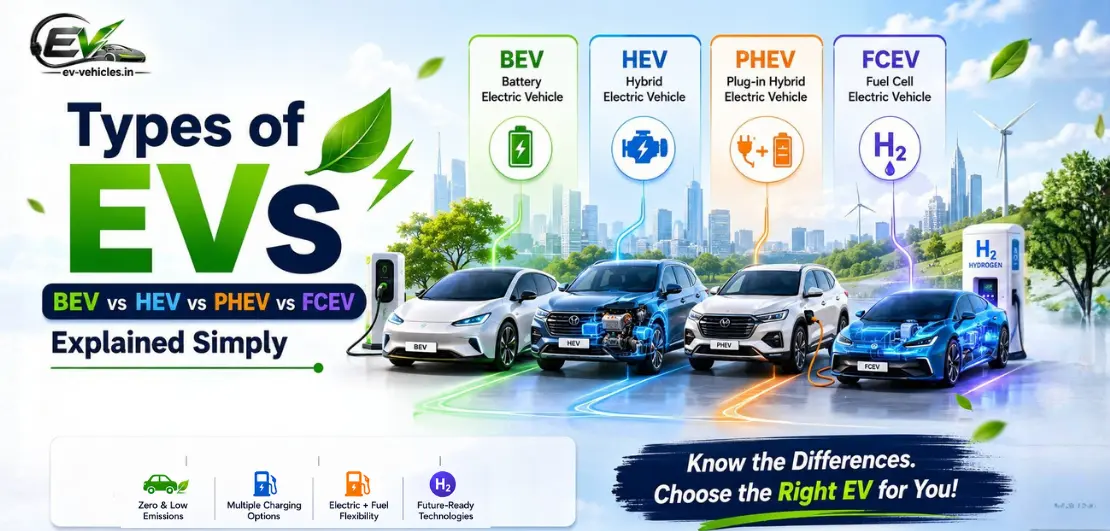
Electric vehicles are rapidly transforming India’s automotive market. From fully electric cars to hybrid and hydrogen-powered vehicles, buyers today have more technology choices than ever before. Understanding the differences between BEV, HEV, PHEV, and FCEV technology is essential for selecting the right vehicle based on driving needs, charging availability, fuel costs, and long-term ownership goals.
Quick Answer: Types of EVs in India
| EV Type | Full Form | External Charging | Fuel Required |
|---|---|---|---|
| BEV | Battery Electric Vehicle | Yes | No |
| HEV | Hybrid Electric Vehicle | No | Yes |
| PHEV | Plug-in Hybrid Electric Vehicle | Yes | Yes |
| FCEV | Fuel Cell Electric Vehicle | No (Hydrogen Refueling) | Hydrogen |
Which EV Type Is Right for You?
| Use Case | Recommended EV Type |
|---|---|
| Daily City Driving | BEV |
| Lowest Running Cost | BEV |
| Long Highway Travel | HEV |
| No Charging Access | HEV |
| City + Highway Driving | PHEV |
| Future Zero-Emission Technology | FCEV |
EV Terminology Explained
Electric vehicle terminology can be confusing for first-time buyers because several abbreviations are commonly used across the automotive industry. The table below explains the most important EV terms used in India and globally.
| Abbreviation | Full Form | Meaning |
|---|---|---|
| EV | Electric Vehicle | Any vehicle that uses electricity for propulsion, either fully or partially. |
| BEV | Battery Electric Vehicle | A fully electric vehicle powered only by rechargeable batteries. |
| HEV | Hybrid Electric Vehicle | A vehicle that combines a fuel engine with an electric motor and battery. |
| PHEV | Plug-in Hybrid Electric Vehicle | A hybrid vehicle that can be externally charged and can drive using electricity alone for limited distances. |
| FCEV | Fuel Cell Electric Vehicle | A vehicle that generates electricity from hydrogen fuel cells to power an electric motor. |
| MHEV | Mild Hybrid Electric Vehicle | A hybrid system where the electric motor assists the engine but cannot independently drive the vehicle. |
| FHEV | Full Hybrid Electric Vehicle | A hybrid vehicle capable of driving short distances using electric power alone without plugging in. |
Understanding these terms makes it easier to compare different electric vehicle technologies and choose the right EV based on your driving requirements, charging access, and fuel preferences.
BEV vs HEV vs PHEV vs FCEV: Key Differences
| Category | Main Energy Source | Tailpipe Emissions | Charging Method |
|---|---|---|---|
| BEV | Battery Electricity | Zero | Plug-in Charging |
| HEV | Petrol + Battery | Low | Regenerative Braking |
| PHEV | Battery + Petrol | Low to Zero in EV Mode | Plug-in + Regenerative Braking |
| FCEV | Hydrogen | Zero | Hydrogen Refueling |
What is an Electric Vehicle (EV)?
An electric vehicle (EV) is a vehicle that uses one or more electric motors for propulsion. Unlike conventional vehicles that rely entirely on an internal combustion engine, EVs use electricity stored in batteries or generated through hydrogen fuel cells.
Electric vehicles can include fully electric models, hybrid vehicles, plug-in hybrids, and hydrogen-powered vehicles.
How EVs Work
EVs convert stored energy into mechanical power that drives the wheels. Depending on the vehicle type, electricity may come from:
- Rechargeable battery packs
- Regenerative braking systems
- Hydrogen fuel cells
- A combination of battery power and conventional fuel
Main Components of an Electric Vehicle
Electric vehicles rely on several key components that work together to store energy, manage power, and drive the vehicle efficiently.
| Component | Function |
|---|---|
| Battery Pack | Stores electrical energy used to power the vehicle |
| Electric Motor | Converts electrical energy into mechanical power |
| Controller | Regulates power flow between the battery and motor |
| Onboard Charger | Converts AC electricity from a charger into DC electricity for the battery |
| Regenerative Braking System | Recovers energy during braking and sends it back to the battery |
| DC/DC Converter | Converts high-voltage battery power into low-voltage power for vehicle electronics |
1. Battery Pack
The battery pack is the primary energy storage system in an electric vehicle. It stores electricity that powers the electric motor and other vehicle systems. Most modern EVs use rechargeable lithium-ion batteries.
2. Electric Motor
The electric motor converts electrical energy from the battery into mechanical energy that turns the wheels. Electric motors deliver instant torque, resulting in smooth and responsive acceleration.
3. Controller
The controller acts as the brain of the electric drivetrain. It manages the flow of electricity between the battery and the motor, helping control speed, power delivery, and overall vehicle performance.
4. Onboard Charger
The onboard charger converts alternating current (AC) from home or public charging stations into direct current (DC) that can be stored in the battery pack.
5. Regenerative Braking System
Regenerative braking captures energy that would normally be lost during braking and converts it back into electricity. This recovered energy is then stored in the battery, helping improve efficiency and driving range.
6. DC/DC Converter
Electric vehicle batteries operate at high voltage, while systems such as lighting, infotainment, and power accessories require lower voltage. The DC/DC converter reduces battery voltage to safely power these components.
How EV Charging Works
Electric vehicles store energy in batteries that power one or more electric motors. Depending on the type of EV, batteries can be charged from an external power source, through regenerative braking, or by using other onboard energy systems.
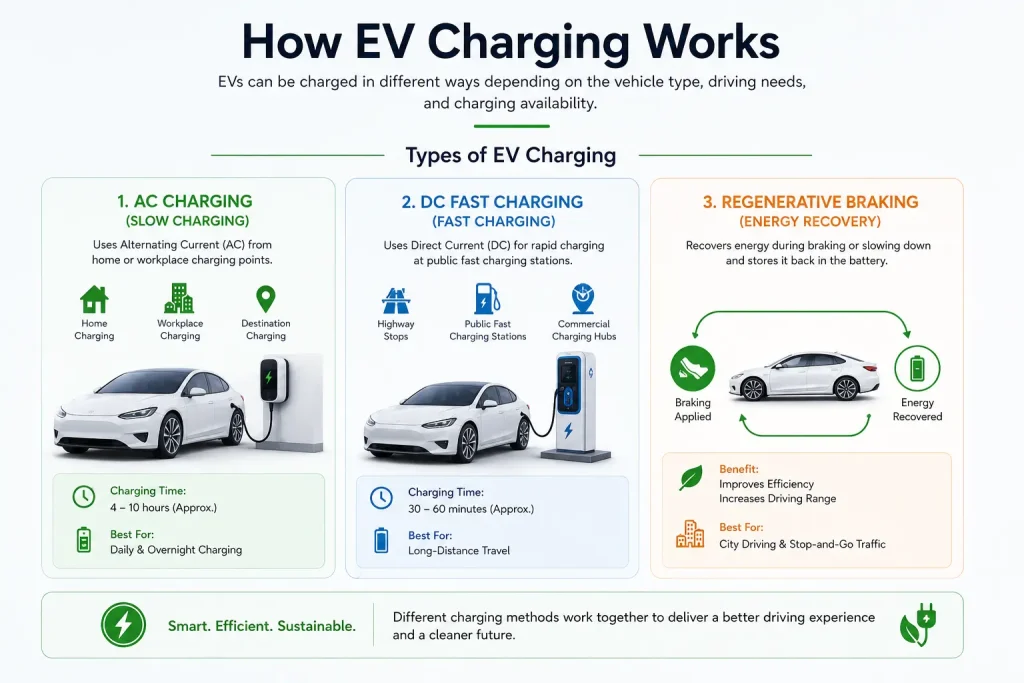
For battery electric vehicles (BEVs) and plug-in hybrid electric vehicles (PHEVs), charging plays an important role in daily usage. Understanding the different charging methods can help buyers choose the right EV based on their driving habits and charging availability.
How Regenerative Braking Works
When a driver slows down or applies the brakes, the electric motor can operate as a generator. Instead of allowing braking energy to be lost as heat, the system converts part of that energy into electricity and stores it back in the battery. This improves overall efficiency and can help extend driving range, particularly in city traffic conditions.
Types of EV Charging
| Charging Type | Power Source | Suitable For |
|---|---|---|
| AC Charging | Home Charging or Workplace Charging | Daily charging |
| DC Fast Charging | Public Fast Charging Stations | Long-distance travel |
| Regenerative Braking | Vehicle Motion | Battery energy recovery |
1. AC Charging
AC (Alternating Current) charging is the most common charging method for electric vehicles. It is typically used at homes, offices, and destination charging locations.
Most EV owners rely on AC charging for overnight charging and routine daily use.
2. DC Fast Charging
DC (Direct Current) fast charging delivers electricity directly to the battery at much higher speeds than AC charging. These chargers are commonly installed at highways, public charging stations, and commercial charging hubs.
DC fast charging is particularly useful for long-distance travel and reducing charging time during road trips.
3. Regenerative Braking
Regenerative braking is a technology that helps recover energy while slowing down or braking. Instead of wasting kinetic energy as heat, the system converts part of that energy into electricity and stores it back in the battery.
This feature improves efficiency and can help increase driving range, especially in city traffic with frequent stop-and-go driving conditions.
Which EV Types Need External Charging?
One of the most common questions among car buyers is whether every electric vehicle needs to be plugged in for charging. The answer depends on the type of EV technology used.
Some electric vehicles require regular charging from an external power source, while others generate or recover electricity internally through regenerative braking or other energy systems.
EV Charging Requirement Comparison
| EV Type | Need Charging Cable? | How It Gets Energy |
|---|---|---|
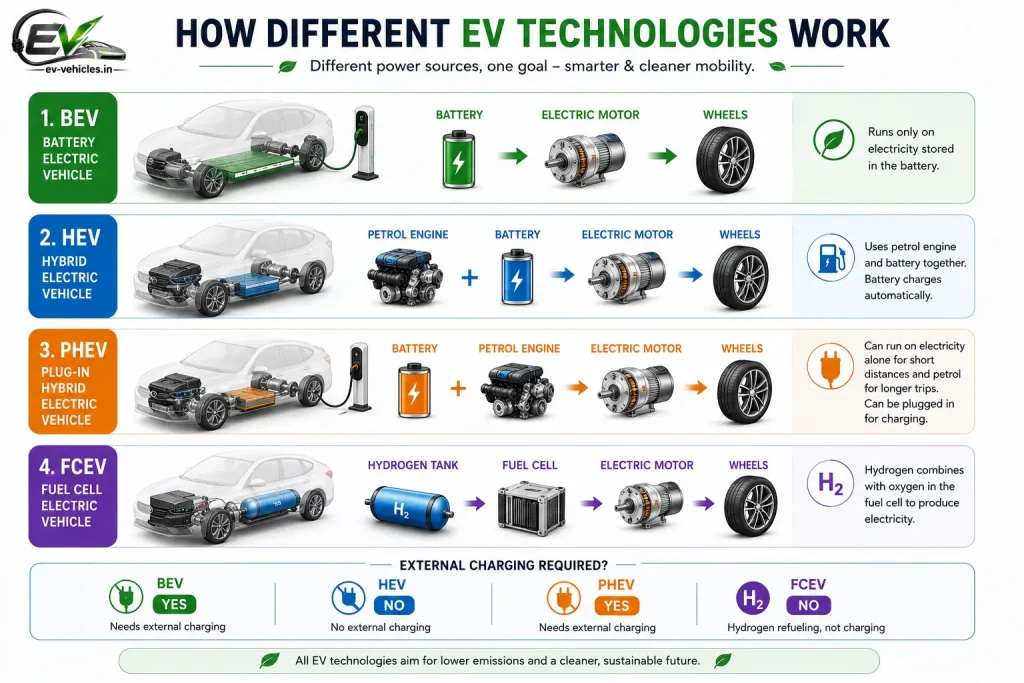
| BEV (Battery Electric Vehicle) | Yes | External charging only |
| HEV (Hybrid Electric Vehicle) | No | Regenerative braking and engine-generated power |
| PHEV (Plug-in Hybrid Electric Vehicle) | Yes | External charging, regenerative braking, and engine support |
| FCEV (Fuel Cell Electric Vehicle) | No | Hydrogen refueling generates electricity onboard |
Quick Explanation
- BEVs must be plugged into a charging station or power source to recharge their batteries.
- HEVs do not require external charging because their batteries are charged through regenerative braking and the vehicle’s engine.
- PHEVs can be plugged in for charging and can also recover energy through regenerative braking. Regular charging helps maximize their electric-only driving capability.
- FCEVs do not use charging cables. Instead, they are refueled with hydrogen, which is converted into electricity through a fuel cell system.
For most buyers in India, BEVs and PHEVs are the primary vehicle types that require access to charging infrastructure.
Types of Electric Vehicles in India
India’s electric mobility ecosystem currently includes four major EV technologies.
1. Battery Electric Vehicles (BEV)
What is a BEV?
A Battery Electric Vehicle (BEV) is a fully electric vehicle powered exclusively by electricity stored in rechargeable battery packs. It does not have a petrol or diesel engine.
BEVs are also called all-electric vehicles or pure electric vehicles.
How It Works
A BEV stores electricity in a battery pack that powers one or more electric motors. The battery is charged by plugging the vehicle into a charging source.
Many BEVs also use regenerative braking, which converts braking energy into electricity and sends it back to the battery.
Advantages of BEVs
- Zero tailpipe emissions
- Lowest running costs among EV technologies
- Quiet driving experience
- Fewer moving parts
- Lower maintenance requirements
- High torque and smooth acceleration
Disadvantages of BEVs
- Dependence on charging infrastructure
- Higher upfront purchase cost
- Range can be affected by driving conditions and temperature
- Charging requires planning for long-distance travel
Popular BEVs in India
Battery electric vehicles currently represent the fastest-growing segment of India’s passenger EV market, with options available across hatchback, SUV, and crossover categories.
| Vehicle | Type |
|---|---|
| Tata Punch EV | BEV |
| Tata Nexon EV | BEV |
| Tata Curvv EV | BEV |
| MG Windsor EV | BEV |
| Mahindra BE 6 | BEV |
| Mahindra XEV 9e | BEV |
2. Hybrid Electric Vehicles (HEV)
What is an HEV?
A Hybrid Electric Vehicle (HEV) combines a conventional internal combustion engine with one or more electric motors and a battery.
Unlike BEVs, HEVs cannot be plugged into an external charger.
How It Works
The electric motor assists the engine during driving, especially at lower speeds and during acceleration. The battery is charged through regenerative braking and energy recovery systems.
Depending on the hybrid system, the electric motor may power the vehicle independently for short distances or simply assist the engine.
Advantages of HEVs
- Better fuel efficiency than conventional vehicles
- No charging infrastructure required
- Longer driving range
- Lower emissions than petrol-only vehicles
- Familiar ownership experience
Disadvantages of HEVs
- Still dependent on fuel
- Not capable of long electric-only driving
- Higher complexity than conventional vehicles
- Tailpipe emissions remain present
Popular HEVs in India
Hybrid vehicles remain popular among buyers seeking better fuel efficiency without depending on charging infrastructure.
| Vehicle |
|---|
| Toyota Innova HyCross Hybrid |
| Toyota Camry Hybrid |
| Maruti Suzuki Grand Vitara Strong Hybrid |
| Toyota Urban Cruiser Hyryder Hybrid |
| Honda City eHEV 2026 |
Why HEVs Remain Popular in India
Hybrid Electric Vehicles continue to attract buyers who want improved fuel efficiency without changing their refueling habits.
Key reasons for their popularity include:
- No need for external charging.
- Suitable for both city and highway driving.
- Lower fuel consumption than conventional petrol vehicles.
- Reduced emissions compared to traditional internal combustion engine vehicles.
- Long driving range without charging concerns.
For many buyers, HEVs provide an easier transition toward electrified mobility while maintaining the convenience of conventional fueling infrastructure.
Types of Hybrid Vehicles
Mild Hybrid Electric Vehicle (MHEV)
MHEVs use a small electric system to assist the engine. The electric motor cannot independently drive the vehicle.
Full Hybrid Electric Vehicle (FHEV)
FHEVs use larger batteries and more powerful motors. They can drive short distances using electricity alone at lower speeds.
3. Plug-in Hybrid Electric Vehicles (PHEV)
What is a PHEV?
A Plug-in Hybrid Electric Vehicle (PHEV) combines battery-electric technology with a conventional fuel engine.
PHEVs can be charged from an external power source while also carrying fuel for extended range.
How It Works
PHEVs use a larger battery than conventional hybrids. The battery powers an electric motor, allowing the vehicle to drive moderate distances using electricity alone.
When battery charge becomes low, the internal combustion engine takes over or assists propulsion.
Many current PHEVs can travel approximately 20 to 60 miles (around 32–96 km) on electricity alone before switching to fuel.
Difference Between HEV and PHEV
| Feature | HEV | PHEV |
|---|---|---|
| Plug-in Charging | No | Yes |
| Electric-Only Driving | Limited | Significant |
| Battery Size | Smaller | Larger |
| Fuel Dependence | Higher | Lower |
Advantages of PHEVs
- Ability to drive on electricity alone for daily commutes
- Reduced fuel consumption
- Longer total driving range
- Flexibility of both electricity and fuel
Disadvantages of PHEVs
- More complex powertrain
- Higher purchase cost
- Requires regular charging to maximize benefits
- Still produces emissions when engine is operating
Why PHEVs Are Different
Plug-in Hybrid Electric Vehicles (PHEVs) combine the advantages of battery-electric vehicles and conventional fuel-powered vehicles. They can operate on electricity alone for shorter daily trips while retaining a petrol engine for longer journeys.
This dual-power approach helps reduce fuel consumption and tailpipe emissions while minimizing concerns about charging availability and driving range.
PHEV Status in India
The PHEV segment remains relatively small in India compared to BEVs and HEVs. While battery electric vehicles and hybrid vehicles have seen wider adoption, plug-in hybrid technology is still emerging in the Indian market.
Key characteristics of the current PHEV landscape include:
- Limited vehicle availability compared to BEVs and HEVs.
- Growing interest in electrified mobility solutions.
- Ability to drive on electricity alone for daily commuting.
- Petrol engine backup for longer journeys.
- Reduced dependence on public charging infrastructure compared to BEVs.
As charging infrastructure expands and EV adoption increases, PHEVs may become a more attractive option for buyers seeking a balance between electric driving and long-distance flexibility.
4. Fuel Cell Electric Vehicles (FCEV)
What is an FCEV?
A Fuel Cell Electric Vehicle (FCEV) uses hydrogen to generate electricity through an electrochemical process.
The generated electricity powers an electric motor similar to a battery electric vehicle.
How Hydrogen Fuel Cells Work
Hydrogen stored in onboard tanks reacts with oxygen inside a fuel cell.
This reaction produces:
- Electricity
- Heat
- Water vapor
The electricity powers the vehicle’s electric motor, while water is the primary by-product.
Advantages of FCEVs
- Zero tailpipe emissions
- Fast refueling compared with battery charging
- Electric driving experience
- Long driving range potential
Disadvantages of FCEVs
- Limited hydrogen infrastructure
- High technology costs
- Limited vehicle availability
- Hydrogen supply network still developing
Current Status in India
Hydrogen fuel cell vehicles remain at an early stage in India. Hydrogen refueling infrastructure is extremely limited, making FCEVs largely a future-focused technology.
BEV vs HEV vs PHEV vs FCEV Comparison
| Feature | BEV | HEV | PHEV | FCEV |
|---|---|---|---|---|
| Battery Powered | Yes | Yes | Yes | Yes |
| Petrol Engine | No | Yes | Yes | No |
| Plug-in Charging | Yes | No | Yes | No |
| Tailpipe Emissions | Zero | Low | Low | Zero |
| Running Cost | Lowest | Moderate | Moderate | Not Yet Established |
| Infrastructure | Growing | Existing | Limited | Very Limited |
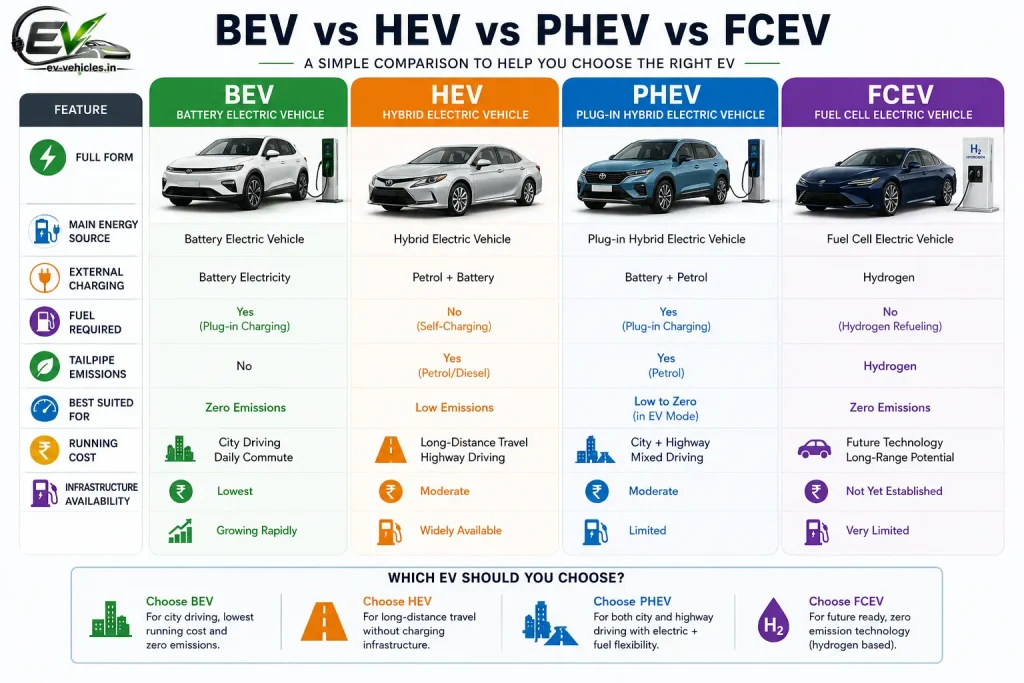
Tailpipe Emissions Comparison
One of the biggest advantages of electric vehicle technology is the potential to reduce vehicle emissions. However, not all EV types produce the same level of emissions because some still use conventional fuel engines.
Tailpipe Emissions by Vehicle Type
| Vehicle Type | Tailpipe Emissions |
|---|---|
| BEV (Battery Electric Vehicle) | Zero |
| FCEV (Fuel Cell Electric Vehicle) | Zero |
| PHEV (Plug-in Hybrid Electric Vehicle) | Low |
| HEV (Hybrid Electric Vehicle) | Low |
| Petrol Vehicle | High |
| Diesel Vehicle | High |
Understanding the Difference
- BEVs produce no direct exhaust or tailpipe emissions because they run entirely on electricity.
- FCEVs also produce zero tailpipe emissions, with water vapor being the primary by-product of the hydrogen fuel cell process.
- PHEVs can operate with zero tailpipe emissions while driving in electric-only mode, but emissions are produced when the fuel engine is used.
- HEVs consume less fuel than conventional vehicles and generally produce lower emissions, but they are not emission-free.
- Petrol and diesel vehicles rely entirely on combustion engines and therefore produce the highest level of tailpipe emissions among the vehicle types compared here.
Reducing tailpipe emissions is one of the key reasons governments and manufacturers around the world are investing heavily in electric mobility technologies.
BEV vs HEV vs PHEV vs FCEV: Which Is Better?
There is no single EV technology that is best for every driver. The ideal choice depends on factors such as daily driving distance, access to charging infrastructure, fuel costs, budget, and long-term ownership goals.
Detailed Comparison of EV Types
| Factor | BEV | HEV | PHEV | FCEV |
|---|---|---|---|---|
| Primary Energy Source | Electricity | Petrol + Electricity | Electricity + Petrol | Hydrogen |
| External Charging Required | Yes | No | Yes | No |
| Fuel Required | No | Yes | Yes | Hydrogen |
| Tailpipe Emissions | Zero | Low | Low to Zero in EV Mode | Zero |
| Running Cost | Lowest | Moderate | Moderate | Not Yet Established |
| Maintenance Requirements | Low | Moderate | Moderate to High | Not Yet Established |
| Driving Range Flexibility | Moderate | High | High | High |
| Charging Dependency | High | None | Moderate | None |
| Refueling Time | Charging Required | Quick Fuel Refill | Fuel Refill + Charging | Fast Hydrogen Refueling |
| Infrastructure Availability | Growing | Widely Available | Limited | Very Limited |
| Technology Maturity in India | High | High | Limited | Early Stage |
Which EV Types Can Run on Electricity Alone?
| EV Type | Can Run Only on Electricity? |
|---|---|
| BEV | Yes |
| HEV | Limited in some models |
| PHEV | Yes, for shorter distances |
| FCEV | Yes (powered by electricity generated from hydrogen fuel cells) |
Choose a BEV If
A Battery Electric Vehicle is the best option if:
- You have access to home or workplace charging.
- Most of your driving is within cities.
- You want the lowest running costs.
- You prefer a zero-tailpipe-emission vehicle.
- Lower maintenance is a priority.
Choose an HEV If
A Hybrid Electric Vehicle may be the better choice if:
- You do not want to depend on charging infrastructure.
- You frequently travel long distances.
- You want better fuel efficiency than a conventional petrol vehicle.
- You prefer a familiar refueling experience.
Choose a PHEV If
A Plug-in Hybrid Electric Vehicle can be suitable if:
- You want electric driving for daily commutes.
- You occasionally travel long distances.
- You have access to charging but still want fuel backup.
- You want a balance between electric mobility and driving flexibility.
Choose an FCEV If
A Fuel Cell Electric Vehicle may become attractive when hydrogen infrastructure expands because:
- It offers zero tailpipe emissions.
- Refueling can be faster than battery charging.
- It combines electric driving with hydrogen-powered energy generation.
- It represents one of the most advanced zero-emission vehicle technologies currently available.
Read more: Electric Car vs Petrol Car: Cost, Maintenance
Which EV Technology Is Currently Most Practical in India?
| Driving Requirement | Recommended EV Type |
|---|---|
| Daily City Commute | BEV |
| Lowest Running Cost | BEV |
| No Charging Access | HEV |
| Long-Distance Travel | HEV |
| City and Highway Combination | PHEV |
| Future-Focused Technology | FCEV |
Verdict
For most urban buyers, BEVs currently offer the strongest combination of low running costs, zero tailpipe emissions, and expanding charging support. Drivers who frequently travel long distances and prefer not to rely on charging infrastructure may find HEVs more practical. PHEVs provide a middle ground between electric and conventional driving, while FCEVs remain a promising future technology as hydrogen infrastructure develops.
EV Adoption in India
Government Support
The Indian government continues to promote electric mobility through various initiatives focused on vehicle electrification, domestic manufacturing, battery production, and charging infrastructure development. Policy support at both central and state levels has played a significant role in accelerating EV adoption across multiple vehicle segments.
Charging Infrastructure
India’s public and private charging network has expanded rapidly in recent years. Charging stations are now available across major cities, highways, commercial hubs, residential communities, and workplace locations. Continued investment in charging infrastructure is helping improve EV accessibility and reducing concerns related to vehicle charging.
Market Trends
India’s EV market has witnessed strong growth over the past few years, with electric vehicles now accounting for approximately 7% to 8% of total vehicle sales across major automotive segments.
Electric two-wheelers and three-wheelers continue to dominate EV adoption and collectively account for the majority of electric vehicle sales in the country. Passenger electric vehicles are also experiencing steady growth as manufacturers introduce new models across multiple price segments.
Key market trends include:
- EV penetration approaching 8% across major vehicle categories.
- Electric two-wheelers remain the largest EV segment by sales volume.
- Passenger electric vehicle adoption continues to rise with new product launches.
- Growing investment in battery manufacturing and localization.
- Increasing availability of fast-charging infrastructure.
- Expansion of electric mobility in commercial and fleet operations.
Why EV Adoption Is Increasing in India
Several factors are contributing to the rapid growth of electric vehicles in India:
| Growth Driver | Impact on EV Adoption |
|---|---|
| Lower Running Costs | Electricity costs are generally lower than petrol and diesel expenses. |
| Expanding Charging Infrastructure | Improved charging access makes EV ownership more practical. |
| Wider Vehicle Choices | More electric cars, SUVs, scooters, and commercial vehicles are available. |
| Government Support | Incentives and policy initiatives encourage EV adoption. |
| Rising Consumer Awareness | More buyers are considering cleaner transportation solutions. |
| Battery Technology Improvements | Better range, performance, and charging capabilities continue to improve EV appeal. |
Challenges
Despite strong growth, several challenges continue to influence EV adoption:
- Higher upfront purchase costs compared to conventional vehicles.
- Charging infrastructure gaps in some regions.
- Range anxiety among first-time EV buyers.
- Limited availability of certain advanced EV technologies such as hydrogen fuel cell vehicles.
Future for the Indian EV Market
Industry forecasts indicate continued growth in EV adoption throughout the remainder of the decade. Battery electric vehicles (BEVs) are expected to remain the primary growth driver, while hybrid technologies continue to attract buyers seeking fuel efficiency and long-distance flexibility. As charging networks expand and battery technology improves, electric mobility is expected to become an increasingly important part of India’s transportation ecosystem.
Advantages of Electric Vehicles
Lower Running Cost: Electricity generally costs less than conventional fuel for daily driving.
Reduced Emissions: BEVs and FCEVs produce zero tailpipe emissions, while HEVs and PHEVs reduce fuel consumption and emissions.
Less Maintenance: Electric motors have fewer moving parts compared to conventional engines.
Quiet Driving: EVs offer smooth and quiet operation with reduced noise and vibration.
Challenges Facing EV Adoption
Charging Infrastructure: Charging networks continue to grow but remain a key area of development.
Higher Upfront Cost: Many EVs still have higher purchase prices than comparable conventional vehicles.
Range Anxiety: Drivers may be concerned about vehicle range and charging availability.
Battery Concerns: Battery performance can be affected by extreme temperatures and long-term degradation concerns.
Future of Electric Vehicles in India
Growth of BEVs: Battery electric vehicles are expected to remain the primary driver of India’s EV transition.
Hybrid Technology Expansion: HEVs and PHEVs are likely to continue serving consumers who want improved fuel efficiency without depending entirely on charging infrastructure.
Hydrogen Development: FCEVs could become more relevant as hydrogen production and refueling infrastructure mature.
Government Targets and Industry Development: Continued investment in EV technology, charging infrastructure, and clean mobility solutions is expected to support long-term market growth.
FAQs
What are the 4 main types of EVs?
The four main types are Battery Electric Vehicles (BEVs), Hybrid Electric Vehicles (HEVs), Plug-in Hybrid Electric Vehicles (PHEVs), and Fuel Cell Electric Vehicles (FCEVs).
Which EV type is most popular in India?
Battery Electric Vehicles (BEVs) currently dominate India’s fully electric passenger vehicle market and are driving much of the country’s EV growth.
What is the difference between BEV and HEV?
A BEV runs entirely on electricity and requires charging, while an HEV combines a fuel engine with an electric motor and does not require plug-in charging.
What is a Plug-in Hybrid?
A Plug-in Hybrid Electric Vehicle (PHEV) combines a rechargeable battery, electric motor, and conventional fuel engine, allowing both electric and fuel-powered driving.
Are hydrogen cars available in India?
Hydrogen fuel cell technology exists, but vehicle availability and refueling infrastructure remain very limited.
Which EV Type Requires the Least Maintenance?
Battery Electric Vehicles (BEVs) generally require the least maintenance because they have fewer moving parts and do not require engine oil changes, fuel system maintenance, or many conventional drivetrain components.
Which EV type has the lowest running cost?
BEVs generally offer the lowest running costs because they operate entirely on electricity.
Which EV type is best for long-distance travel?
HEVs are currently among the most practical options for long-distance travel because they do not depend on charging infrastructure and can be refueled quickly.
Is a Hybrid Car an EV?
A hybrid electric vehicle (HEV) uses both an internal combustion engine and an electric motor. While hybrids use electricity to improve efficiency, they are different from fully electric vehicles because they still rely on conventional fuel.
Does a Hybrid Car Need Charging?
No. Most HEVs do not require external charging. Their batteries are charged through regenerative braking and energy recovery systems while driving.
Which EV Type Has Zero Emissions?
Battery Electric Vehicles (BEVs) and Fuel Cell Electric Vehicles (FCEVs) produce zero tailpipe emissions during operation.
What Is Regenerative Braking?
Regenerative braking is a system that captures energy normally lost during braking and converts it into electricity. This recovered energy is stored in the battery and helps improve vehicle efficiency.
What Is the Difference Between MHEV and FHEV?
A Mild Hybrid Electric Vehicle (MHEV) uses a small electric system to assist the engine but cannot drive the vehicle using electricity alone. A Full Hybrid Electric Vehicle (FHEV) has a larger battery and electric motor that can power the vehicle independently for short distances at low speeds.
Which EV Is Best for Indian Roads?
The best EV depends on driving needs. BEVs are generally well suited for city commuting, HEVs are practical for long-distance travel, and PHEVs offer a balance between electric driving and fuel-powered flexibility.
Can a PHEV Run Without Petrol?
A PHEV can operate on electricity alone while battery charge is available. Once the battery is depleted, the vehicle typically relies on its fuel engine. The exact operation depends on the vehicle’s design and battery charge level.
Do All Electric Vehicles Need Charging Stations?
No. BEVs and PHEVs can be charged using external charging equipment, while HEVs charge through regenerative braking and engine-generated power. FCEVs use hydrogen refueling instead of plug-in charging.
Which EV Type Is Easiest to Own?
For most city users, BEVs are often the easiest to own when home or workplace charging is available. For buyers without charging access, HEVs can offer a simpler ownership experience because they do not require external charging.
