

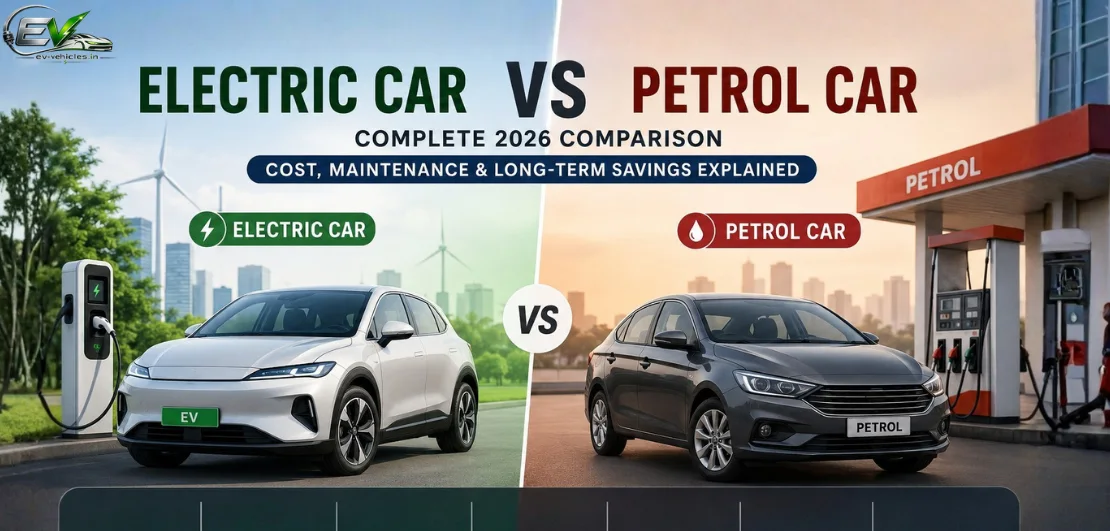
Electric vehicles are gaining popularity in India as buyers look for lower running costs and reduced dependence on rising fuel prices. While petrol cars remain the preferred choice for long-distance travel and areas with limited charging infrastructure, EVs offer lower maintenance costs, quieter operation, and significant long-term savings for many urban drivers. This guide compares both options across cost, performance, ownership, and practicality.
Rising fuel prices, changing driving habits, and growing interest in cleaner mobility have made electric cars one of the biggest topics in India’s automotive market. Buyers who once compared petrol and diesel vehicles are now increasingly comparing electric cars with petrol-powered alternatives.
The decision is no longer just about purchase price. Running costs, maintenance expenses, resale value, charging convenience, and long-term ownership savings all play a major role. Understanding these factors can help buyers choose the right vehicle for their lifestyle and budget.
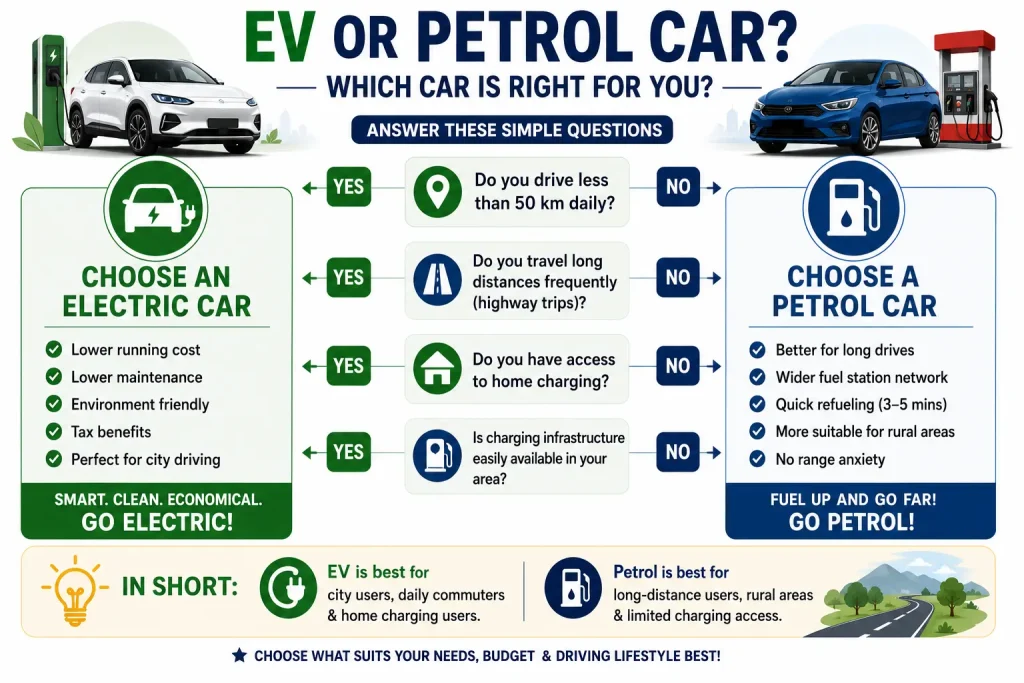
Electric Car vs Petrol Car: Facts
| Factor | Electric Car | Petrol Car |
|---|---|---|
| Energy Source | Battery & Electricity | Petrol Fuel |
| Running Cost | Lower | Higher |
| Maintenance | Lower | Higher |
| Engine Components | Fewer Moving Parts | Complex Engine System |
| Noise Levels | Very Quiet | Moderate |
| Emissions | Zero Tailpipe Emissions | Produces Exhaust Emissions |
| Refueling Time | Longer Charging Time | Quick Refueling |
| Purchase Cost | Higher Initially | Lower Initially |
| Urban Driving | Excellent | Good |
| Long-Distance Travel | Depends on Charging Access | Excellent |
How Electric Cars Differ from Petrol Cars
The biggest difference between electric and petrol vehicles is how they generate power.
Petrol cars use an internal combustion engine that burns fuel to produce energy. The engine contains multiple moving components such as pistons, spark plugs, injectors, filters, and engine oil systems.
Electric cars use battery packs and electric motors instead of traditional engines. Electricity stored in the battery powers the motor, which drives the wheels directly.
This difference affects everything from fuel costs and maintenance expenses to driving experience and environmental impact.
Electric Car vs Petrol Car Comparison Table
| Parameter | Electric Car | Petrol Car |
|---|---|---|
| Purchase Cost | Higher | Lower |
| Running Cost | Very Low | Higher |
| Maintenance | Lower | Higher |
| Fuel/Charging Cost | Electricity | Petrol |
| Service Cost | Lower | Moderate to High |
| Pollution | No Tailpipe Emissions | Produces Emissions |
| Performance | Instant Torque | Smooth Power Delivery |
| Noise | Almost Silent | Engine Noise Present |
| Range | Limited by Battery Capacity | Depends on Fuel Tank |
| Resale Value | Growing Market | Established Market |
Initial Purchase Cost Comparison
Electric Car Price
One of the biggest barriers to EV adoption remains the initial purchase price.
Electric vehicles typically cost more than comparable petrol models because battery packs represent a significant portion of manufacturing costs. Advanced battery technology, power electronics, and charging systems increase the upfront investment.
However, many buyers evaluate EVs based on total ownership costs rather than purchase price alone.
Petrol Car Price
Petrol cars continue to enjoy a lower entry price across most vehicle segments.
The technology is mature, production volumes are high, and manufacturers have decades of experience building petrol-powered vehicles efficiently. This allows buyers to enter the market with a smaller initial investment.
Running Cost Comparison
Running cost is often where electric vehicles gain their biggest advantage.
Petrol vehicles are affected by fuel prices, which have remained high in major Indian cities. Depending on fuel efficiency and city prices, petrol vehicle running costs can vary significantly.
Electric vehicles use electricity instead of petrol. As a result, energy costs per kilometre are generally much lower than fuel-powered vehicles.
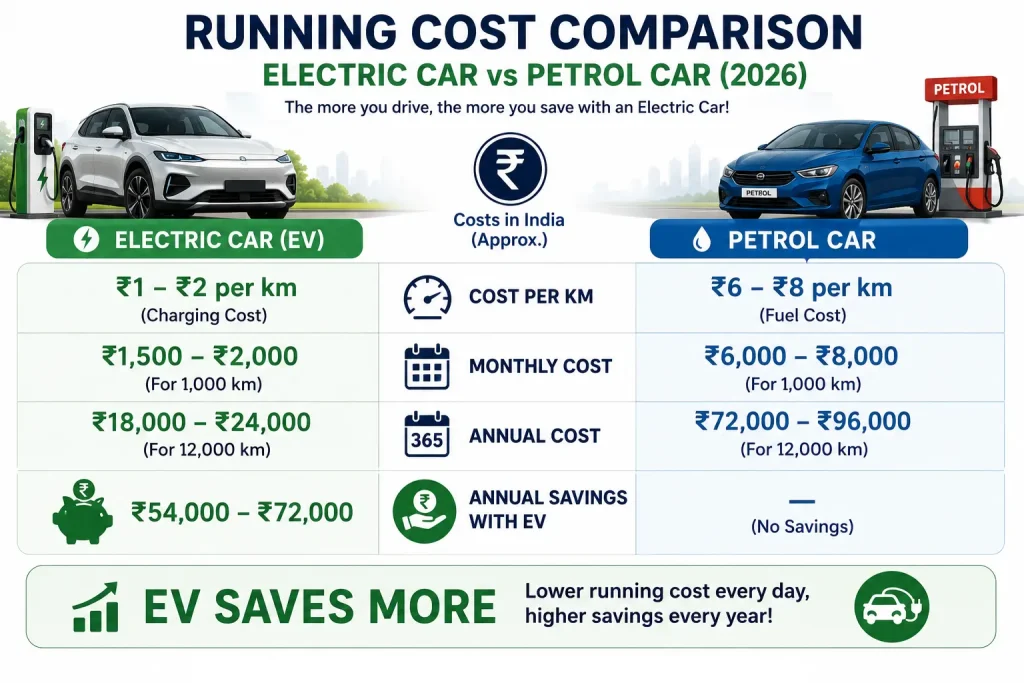
Estimated Running Cost Comparison (as per 1000 km monthly)
| Parameter | Electric Car | Petrol Car |
|---|---|---|
| Cost Per Km | ₹1–2 | ₹6–8 |
| Monthly Distance | 1,000 km | 1,000 km |
| Monthly Cost | ₹1,500 | ₹7,000 |
| Annual Cost | ₹18,000 | ₹84,000 |
| Annual Savings | ₹66,000 | — |
Electric vehicles generally offer a much lower cost per kilometre because electricity is cheaper than petrol. For drivers covering regular daily distances, the savings can become substantial over a few years of ownership.
While EVs typically cost more initially, their lower running and maintenance costs can help offset the higher purchase price over time.
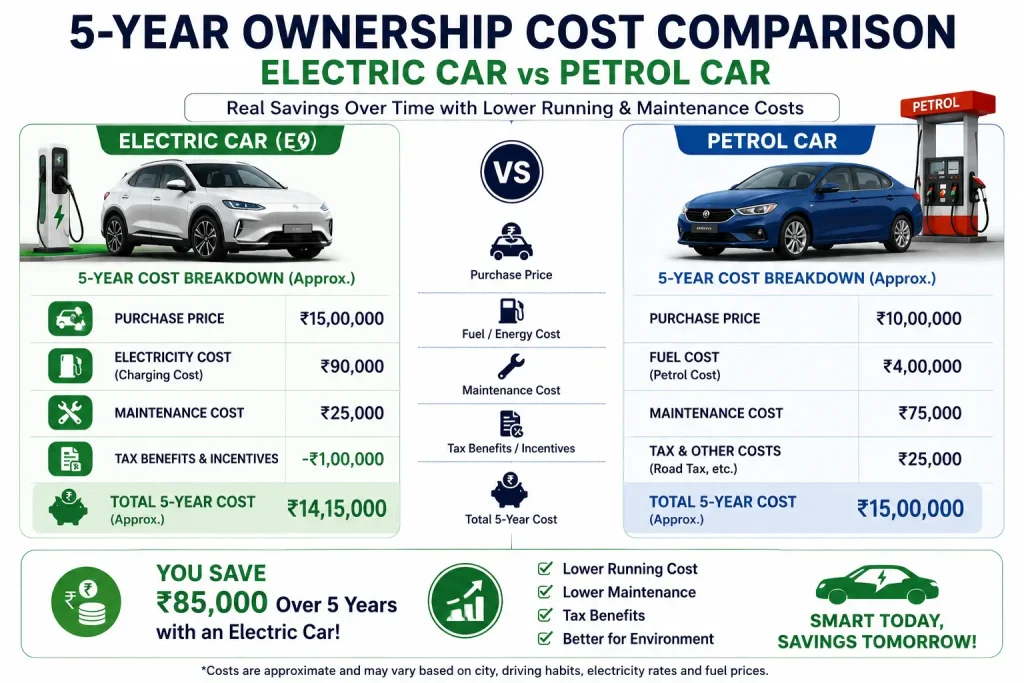
5-Year Ownership Cost Comparison
| Expense | Electric Car | Petrol Car |
|---|---|---|
| Purchase Price | ₹15 lakh | ₹10 lakh |
| Fuel/Electricity | ₹90,000 | ₹4 lakh |
| Maintenance | ₹25,000 | ₹75,000 |
| Total Ownership Cost | ₹15.95 lakh | ₹14.75 lakh |
| Expense | Electric Car | Petrol Car |
|---|---|---|
| Purchase Price | Higher | Lower |
| Energy/Fuel Cost | Lower | Higher |
| Maintenance Cost | Lower | Higher |
| Service Requirements | Minimal | Regular |
| Overall Running Cost | Lower | Higher |
The break-even point is the stage at which the savings from lower charging and maintenance expenses begin to offset the higher purchase cost of an electric vehicle. Buyers who drive more kilometres annually generally reach this point faster than low-mileage users.
How Driving Distance Affects EV Savings
| Annual Distance | Petrol Vehicle | Electric Vehicle |
|---|---|---|
| 10,000 km | Higher fuel expenditure | Lower charging expenditure |
| 15,000 km | Significant fuel costs | Lower energy costs |
| 20,000+ km | Running costs rise sharply | Greater savings potential |
The more kilometres a vehicle covers each year, the larger the potential savings from switching to electricity.
Maintenance Cost Comparison
One of the biggest advantages of EVs is their simpler mechanical design.
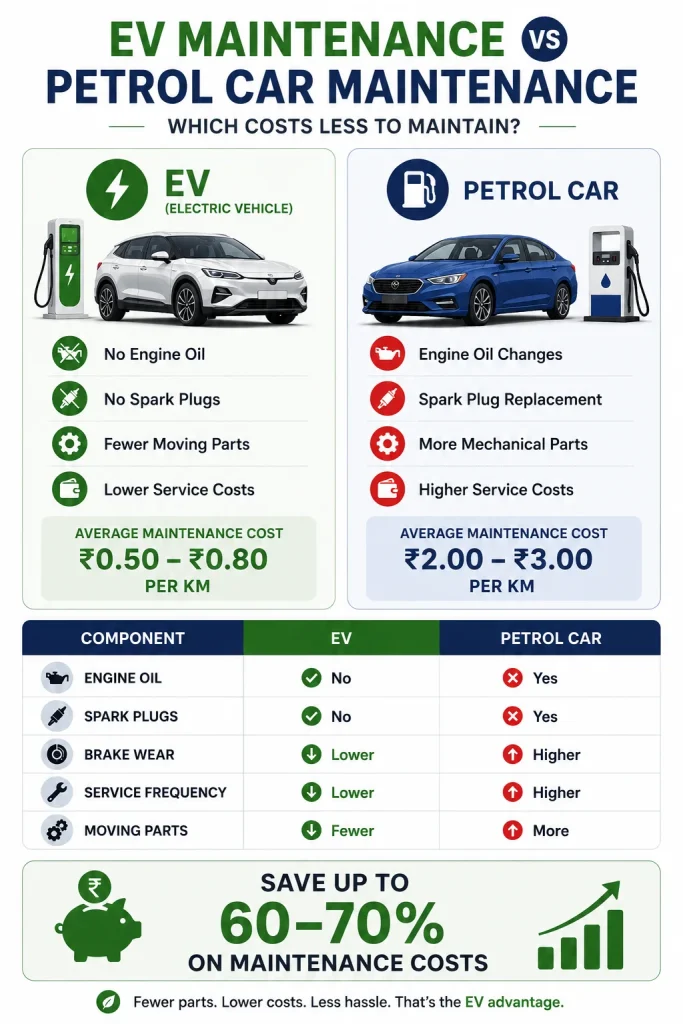
EV vs Petrol Maintenance Requirements:
| Component | Electric Car | Petrol Car |
|---|---|---|
| Engine Oil | Not Required | Required |
| Spark Plugs | Not Required | Required |
| Brake Wear | Lower | Higher |
| Service Frequency | Lower | Higher |
Because electric vehicles have fewer moving parts, they typically require less routine servicing compared to petrol-powered vehicles.
Charging vs Fueling
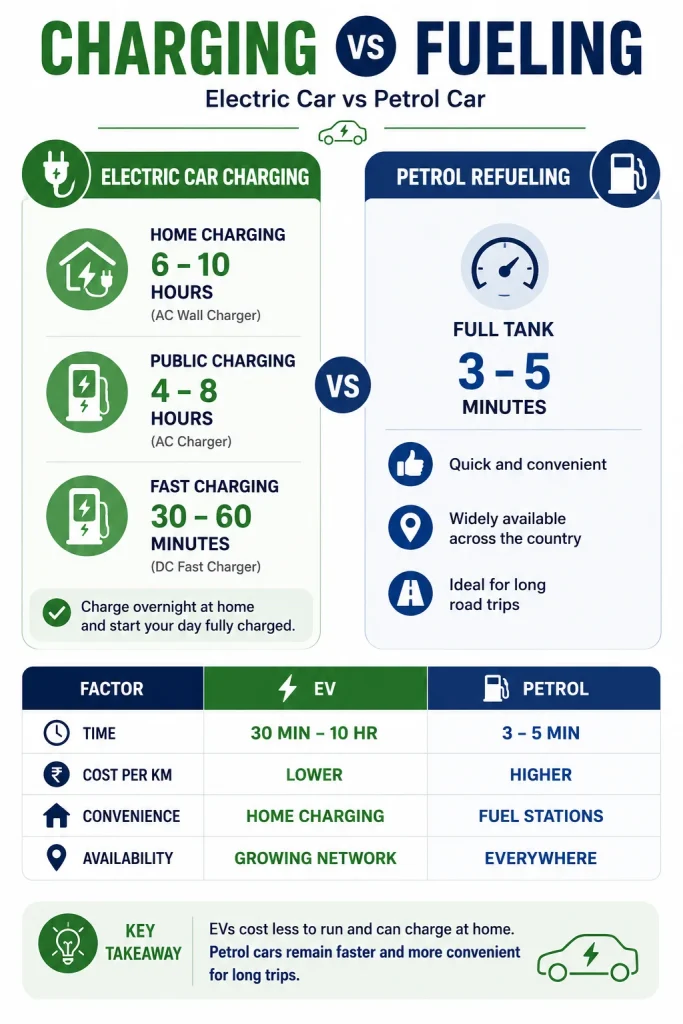
EV Charging Time
Charging times vary depending on charger type and battery size.
Home charging is generally slower but convenient for overnight charging. Fast-charging solutions can reduce charging times considerably, though they are not as quick as filling a fuel tank.
Petrol Refueling Speed
Petrol vehicles retain a major advantage in convenience.
Refueling usually takes only a few minutes and fuel stations remain widely available throughout India.
Home Charging Convenience
For many EV owners, home charging is one of the biggest advantages.
Instead of visiting a fuel station regularly, owners can charge their vehicles overnight and begin each day with a fully charged battery.
How Electric Cars Can Save Money Over Time
Although electric cars usually cost more upfront, they can reduce ownership expenses through lower charging costs and reduced maintenance requirements. The actual savings depend on how much the vehicle is driven each year.
Estimated Annual Running Cost Comparison
| Annual Distance | Electric Car | Petrol Car | Potential Savings |
|---|---|---|---|
| 10,000 km | ₹15,000–20,000 | ₹60,000–80,000 | ₹40,000–60,000 |
| 15,000 km | ₹22,000–30,000 | ₹90,000–1,20,000 | ₹60,000–90,000 |
| 20,000 km | ₹30,000–40,000 | ₹1.2–1.6 lakh | ₹80,000–1.2 lakh |
| 30,000 km | ₹45,000–60,000 | ₹1.8–2.4 lakh | ₹1.2–1.8 lakh |
Where Electric Cars Save Money
- Lower electricity cost per kilometre
- No engine oil changes
- No spark plug replacements
- Fewer moving mechanical components
- Lower routine servicing expenses
- Reduced brake wear through regenerative braking
- Government incentives and tax benefits in some regions
Example Ownership Scenario
| Ownership Factor | Electric Car | Petrol Car |
|---|---|---|
| Energy/Fuel Cost | Lower | Higher |
| Maintenance Cost | Lower | Higher |
| Service Visits | Less Frequent | More Frequent |
| Running Cost | Lower | Higher |
| Long-Term Savings Potential | Higher | Lower |
Who Benefits Most?
Electric cars generally provide the greatest financial advantage to:
- Daily commuters
- City drivers
- Families with predictable travel patterns
- Owners planning to keep their vehicle for several years
- Users with access to home charging
As annual driving distance increases, the savings from lower charging and maintenance costs become more noticeable, making EVs particularly attractive for frequent users.
Performance Comparison
EV Instant Torque: Electric motors deliver torque instantly. This results in quick acceleration from a standstill and smooth response in city traffic.
Smooth Driving Experience: Electric vehicles provide:
- Silent operation
- Minimal vibration
- Smooth acceleration
- Relaxed urban driving
Highway Performance: Petrol vehicles continue to offer advantages for long-distance journeys because refueling is fast and fuel stations are widely available.
Electric vehicles can handle highway driving effectively, but route planning and charging availability remain important considerations.
Environmental Impact
Environmental considerations are becoming increasingly important for vehicle buyers.
Electric Cars
- No tailpipe emissions
- Reduced urban air pollution
- Support cleaner mobility initiatives
Petrol Cars
- Produce carbon emissions
- Generate exhaust gases during operation
- Depend on fossil fuels
As cities focus on cleaner transportation, electric vehicles are increasingly viewed as a sustainable mobility solution.
Battery Life and Replacement Cost
Battery technology has improved significantly, making modern EVs more practical for long-term ownership.
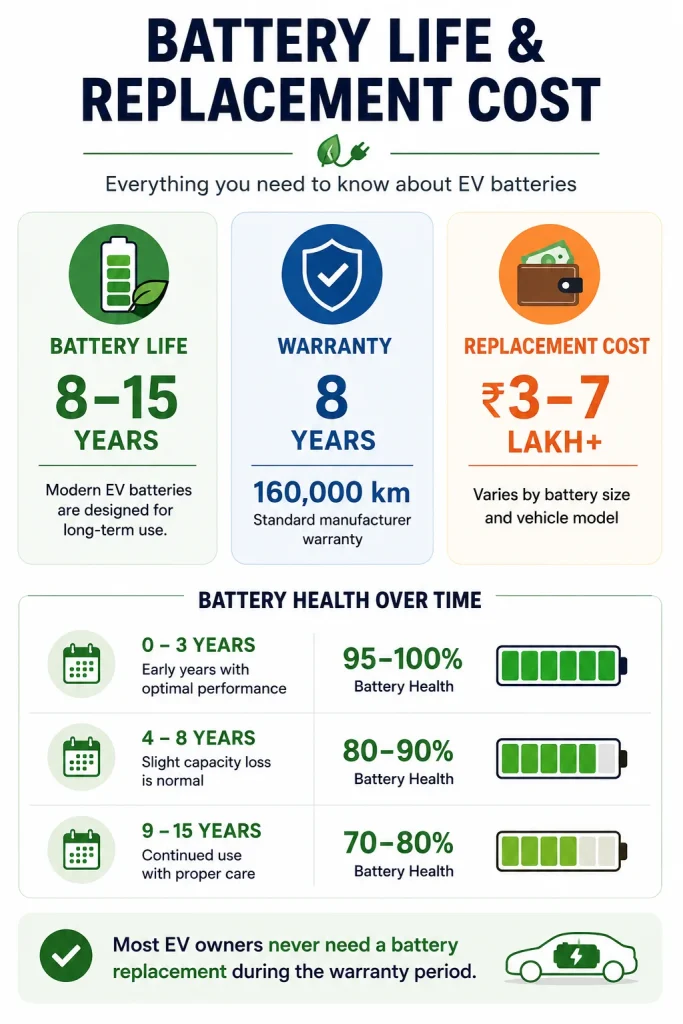
Battery Life Overview:
| Item | Typical Value |
|---|---|
| Battery Warranty | Up to 8 Years |
| Battery Lifespan | 8–15 Years |
| Replacement Concern | Major Ownership Consideration |
Most manufacturers provide long-term battery warranties, helping reduce buyer concerns regarding durability and replacement costs.
Range Anxiety vs Fuel Availability
Charging Network Growth: India’s charging infrastructure continues to expand as EV adoption grows. More public charging stations are being installed across highways, cities, and commercial locations.
Petrol Pump Availability: Petrol stations remain far more widespread and accessible than charging stations. This continues to be a major advantage for conventional vehicles.
Real-World Driving Concerns: Many city users can comfortably manage daily travel within an EV’s range. Long-distance drivers may still prefer petrol vehicles because fuel availability is nearly universal.
Government Subsidies and Tax Benefits
Government incentives have played an important role in encouraging EV adoption across India.
Benefits Available to EV Buyers
- State-level EV subsidies in select regions
- Registration fee exemptions in some states
- Road tax savings
- Reduced ownership costs
- Incentives designed to promote cleaner transportation
These benefits can help reduce the overall cost of owning an electric vehicle and improve long-term affordability.
Who Should Buy an Electric Car?
Electric vehicles are particularly suitable for:
- Daily city commuters
- Urban families
- Drivers covering predictable distances
- Homeowners with charging access
- Buyers focused on lower running costs
- Environment-conscious consumers
Who Should Buy a Petrol Car?
Petrol vehicles remain a strong choice for:
- Frequent highway travellers
- Rural users
- Buyers without charging access
- Long-distance drivers
- People seeking lower upfront costs
- Owners who value quick refueling convenience
Popular Electric Cars Available in India
India’s EV market has expanded rapidly in recent years, giving buyers more choices than ever before. From affordable hatchbacks and compact SUVs to premium electric vehicles and long-range family cars, manufacturers now offer EVs across multiple price segments. This growing variety has played a major role in accelerating electric vehicle adoption across India.
| Brand | Popular EV Models | Segment |
|---|---|---|
| Tata Motors | Tiago EV, Tigor EV, Punch EV, Nexon EV, Curvv EV, Harrier EV | Hatchback, Sedan, SUV |
| MG Motor | Comet EV, Windsor EV, ZS EV | City EV, Family EV, SUV |
| Mahindra | BE 6, XEV 9e, XEV 9S | Premium Electric SUVs |
| Hyundai | Creta Electric, Ioniq 5 | Electric SUV, Premium EV |
| Maruti Suzuki | e Vitara | Electric SUV |
| BYD | Atto 3, Seal, eMAX 7 | Premium EVs |
| Toyota | Urban Cruiser EV/Ebella | Electric SUV |
| VinFast | VF 6, VF 7 | Electric SUVs |
| Tesla | Model Y | Premium Electric SUV |
India’s electric car market is no longer limited to a few compact EVs. Tata Motors continues to offer some of the most accessible electric cars, while MG has strong city and family EV options. Mahindra has entered the premium electric SUV space with models like BE 6 and XEV 9e, while Hyundai and Maruti Suzuki have also expanded the EV market with Creta Electric and e Vitara. Premium buyers also have options from BYD, Toyota, VinFast, and Tesla.
These vehicles cater to different budgets and usage requirements while expanding consumer choice in the EV market.
Read more: E20 vs E85 Fuel: Difference, Mileage, Price, Compatible Vehicles
Why More Indians Are Comparing EVs and Petrol Cars
The traditional petrol-versus-diesel debate is gradually evolving into a petrol-versus-electric discussion. Higher fuel prices, stricter emissions requirements, growing EV infrastructure, and changing ownership patterns are reshaping buying decisions across India.
For many urban buyers, the decision increasingly depends on total ownership cost rather than just the showroom price.
Future of Electric Cars in India
Electric vehicle adoption is expected to continue growing as charging networks expand and battery technology improves. At the same time, petrol vehicles are likely to remain important for buyers who prioritize long-distance travel, lower purchase costs, and maximum convenience.
The future market is expected to include a mix of electric, petrol, hybrid, and alternative-fuel vehicles, allowing consumers to choose the option that best suits their driving needs and budget.
Conclusion
The choice between an electric car and a petrol car depends on how and where you drive. Electric vehicles offer lower running costs, reduced maintenance requirements, quiet operation, and a cleaner driving experience, making them highly attractive for city users and daily commuters. Petrol cars continue to provide lower upfront costs, widespread refueling access, and greater convenience for long-distance travel.
For buyers covering predictable daily distances with access to charging, an EV can deliver substantial long-term savings. For frequent highway users and drivers in areas where charging infrastructure is limited, petrol cars remain a practical and dependable option. As India’s EV ecosystem continues to grow, electric mobility is becoming an increasingly compelling choice for the next generation of car buyers.
