

India has entered a new phase of ethanol-based mobility with the launch of E85 fuel at ₹82.12 per litre in Delhi. While E20 remains the standard fuel for most petrol vehicles, E85 is designed for flex-fuel vehicles and offers a lower pump price, although its lower energy density can result in higher fuel consumption and reduced mileage. Here is a complete guide to E20 and E85 fuels, their differences, compatible vehicles, mileage impact, technology requirements, and future prospects in India
| Quick Answer | Details |
|---|---|
| What is E20? | 20% Ethanol + 80% Petrol |
| What is E85? | 80-85% Ethanol + 15-20% Petrol |
| Can E85 be used in normal cars? | No |
| E85 Price in Delhi | ₹82.12/litre |
| E20 Price in Delhi | ₹102.12/litre |
| Mileage Loss on E85 | Approximately 25-35% |
| Cost Per Km Advantage | Depends on vehicle mileage |
| Future of E20 | Will continue as mainstream fuel |
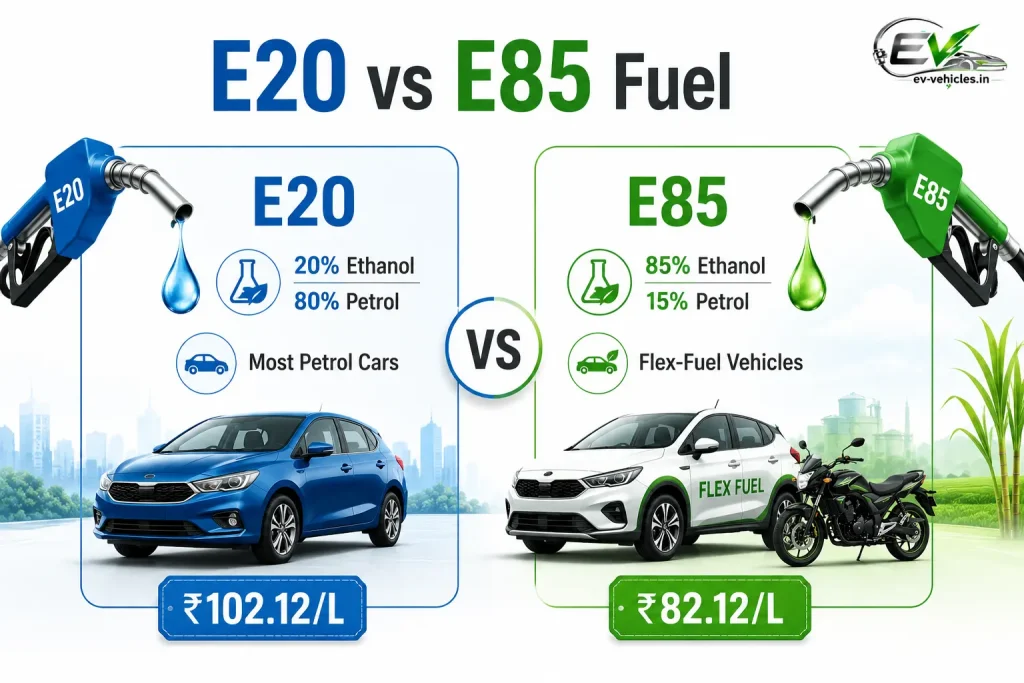
E20 is currently the standard petrol blend used by most vehicles in India and contains 20% ethanol. E85 contains up to 85% ethanol and can only be used in specially designed flex-fuel vehicles. While E85 is ₹20 per litre cheaper than E20 petrol in Delhi, its lower energy content can lead to 25-35% lower fuel efficiency.
India’s ethanol blending programme has entered a new chapter with the commercial launch of E85 fuel. After successfully achieving nationwide E20 rollout, the country is now preparing for higher ethanol blends as part of its strategy to reduce crude oil imports, improve energy security, support farmers, and lower emissions.
The introduction of E85 fuel in Delhi has sparked widespread interest among vehicle owners. While E20 is already available across India and compatible with most modern petrol vehicles, E85 is a new fuel designed specifically for flex-fuel vehicles.
This guide explains how E20 and E85 differ, their impact on mileage and performance, which vehicles can use them, and what the future holds for ethanol-powered mobility in India.
| Year | Development |
|---|---|
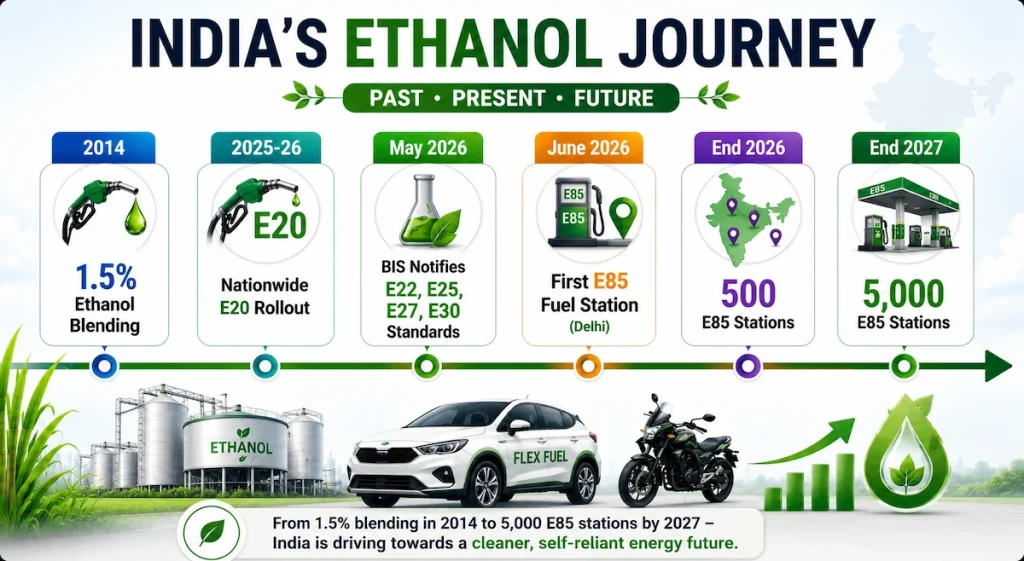
| 2014 | Ethanol blending around 1.5% |
| 2025-26 | Nationwide E20 rollout |
| May 2026 | E22, E25, E27, E30 standards notified |
| June 2026 | First E85 fuel station launched |
| End-2026 | Target 500 E85 stations |
| End-2027 | Target 5,000 E85 stations |
What is E20 Fuel?
E20 fuel is a blend containing 20% ethanol and 80% petrol. It has become the standard petrol blend available across India and forms the backbone of the country’s ethanol blending programme.
The government achieved its 20% ethanol blending target ahead of schedule, making E20 the default fuel for most petrol vehicles sold in India today.
Benefits of E20
- Reduces dependence on imported crude oil
- Supports domestic ethanol production
- Lowers carbon emissions
- Compatible with most modern petrol vehicles
- Requires minimal infrastructure changes
- Enables gradual transition toward cleaner fuels
What is E85 Fuel?
E85 is a high-ethanol fuel blend containing approximately 80-85% ethanol and 15-20% petrol.
India officially introduced E85 fuel in June 2026 with the inauguration of the first E85 dispensing station in Delhi. The fuel has been launched specifically for flex-fuel vehicles capable of operating on high ethanol concentrations.
The government has priced E85 at ₹82.12 per litre in Delhi, making it ₹20 cheaper than E20 petrol.
Purpose of E85
- Increase ethanol consumption
- Reduce fossil fuel dependence
- Promote flex-fuel vehicle adoption
- Support agricultural and biofuel industries
- Lower transportation emissions
E20 vs E85 Fuel: Comparison Table
| Parameter | E20 | E85 |
|---|---|---|
| Ethanol Content | 20% | 80-85% |
| Petrol Content | 80% | 15-20% |
| Compatible Vehicles | Most modern petrol vehicles | Flex-Fuel Vehicles only |
| Fuel Price (Delhi) | ₹102.12/litre | ₹82.12/litre |
| Mileage | Slightly lower than petrol | 25-35% lower than E20 |
| Emissions | Lower than regular petrol | Lower fossil-carbon emissions |
| Performance | Similar to petrol | Higher octane potential |
| Availability | Nationwide | Limited rollout |
| Maintenance Impact | Minimal for compatible vehicles | Requires specialized components |
| Future Scope | Mainstream fuel | Growing alternative fuel |
Difference Between E20 and E85 Petrol
1. Ethanol Blend Percentage
The biggest difference lies in ethanol concentration.
- E20 contains 20% ethanol.
- E85 contains 80-85% ethanol.
This higher ethanol concentration dramatically changes fuel characteristics and vehicle requirements.
2. Engine Compatibility
Most modern petrol vehicles can operate on E20.
E85, however, requires specially engineered flex-fuel vehicles equipped with ethanol-resistant fuel systems and advanced engine management software.
3. Fuel Economy
Ethanol contains less energy than petrol.
As a result:
- E20 may cause only a small reduction in mileage.
- E85 can reduce fuel economy by approximately 25-35%.
4. Emissions
Both fuels help reduce emissions compared to conventional petrol.
E85 generally offers a greater reduction in fossil-fuel dependence due to its significantly higher ethanol content.
5. Engine Performance
E85 offers a higher octane rating, allowing improved combustion in engines specifically designed for high ethanol blends.
6. E20 vs E85 Running Cost Example
| Parameter | E20 | E85 |
|---|---|---|
| Fuel Price | ₹102.12/litre | ₹82.12/litre |
| Mileage Example | 15 kmpl | 11 kmpl |
| Cost Per Km | ₹6.81 | ₹7.47 |
Note: This is only an illustrative example based on assumed mileage figures. Actual fuel economy and running costs may vary depending on the vehicle, engine calibration, driving style, traffic conditions, and fuel efficiency.
Despite being ₹20 cheaper per litre, E85 may not always be cheaper per kilometre because ethanol contains less energy than petrol. As a result, flex-fuel vehicles generally consume more fuel to travel the same distance. The real-world cost advantage of E85 will depend on the final mileage delivered by individual flex-fuel vehicles.
Why Is India Promoting E85 If Running Costs May Be Higher?
The government’s objective extends beyond reducing fuel expenses for individual vehicle owners. E85 is being promoted as part of a broader energy, environmental, and agricultural strategy.
Benefits of E85
- Lower crude oil imports: Higher ethanol usage can reduce India’s dependence on imported petroleum products.
- Improved energy security: Greater use of domestically produced fuel can help shield the economy from global oil price volatility.
- Support for farmers: Ethanol production from sugarcane, maize, and other agricultural feedstocks can create additional income opportunities for farmers.
- Reduced fossil-fuel consumption: E85 contains significantly less petrol than conventional fuels.
- Lower emissions: Higher ethanol blends can contribute to cleaner transportation and reduced carbon emissions.
- Development of a flex-fuel ecosystem: E85 creates an additional alternative-fuel pathway alongside EVs, hybrids, CNG, and future hydrogen technologies.
- Expansion of domestic biofuel industry: Higher ethanol demand can support investments in biofuel production and related infrastructure.
Verdict
For individual consumers, E85’s biggest attraction is its lower pump price. For India, however, the larger benefits are reduced oil imports, improved energy security, stronger farmer incomes, and a more diversified transportation fuel ecosystem.
Why is E85 Fuel ₹20 Cheaper Than E20?
E85 is priced ₹20 per litre lower than E20 petrol because ethanol contains less energy than petrol. The lower price has been structured to compensate consumers for the expected reduction in fuel efficiency. The pricing strategy is also intended to encourage adoption of flex-fuel vehicles and support the government’s broader ethanol blending programme.
How E20 Fuel Works
E20 functions similarly to conventional petrol but contains additional ethanol.
When burned inside the engine:
- Ethanol improves oxygen availability during combustion.
- Fuel burns more completely.
- Emissions are reduced.
Modern manufacturers have calibrated their engines to safely handle E20 fuel without significant performance changes.
How E85 Fuel Works
E85 requires specialized flex-fuel technology.
Flex-Fuel Technology: Flex-fuel vehicles are engineered to run on varying ethanol concentrations, from E20 up to E85 and beyond.
Fuel Sensors: Special sensors continuously monitor ethanol concentration and adjust engine parameters.
Engine Calibration: The ECU automatically modifies:
- Fuel injection timing
- Ignition timing
- Air-fuel ratios
Ethanol Combustion: Because ethanol burns differently from petrol, flex-fuel engines are optimized to maintain performance despite changing fuel compositions.
Mileage Comparison: E20 vs E85
The primary disadvantage of higher ethanol blends is lower energy density.
Why Ethanol Affects Mileage: Ethanol contains roughly one-third less energy than petrol. Therefore, more fuel is required to travel the same distance.
Real-World Mileage Expectations:
| Parameter | E20 | E85 |
|---|---|---|
| Mileage Reduction | Typically 1-8% | Typically 25-35% |
| Fuel Consumption | Slightly higher | Significantly higher |
| Running Cost Advantage | Stable | Depends on fuel price advantage |
Cost Savings vs Mileage Loss: The ₹20-per-litre price advantage for E85 has been introduced to partially compensate consumers for the lower energy content of ethanol and the expected reduction in fuel efficiency compared to E20 petrol.
However, the final running cost depends on how efficiently a flex-fuel vehicle performs under real-world conditions.
Engine Technology Required
Vehicles Compatible with E20
Most modern petrol vehicles manufactured in recent years have been designed or calibrated for E20 compatibility.
Manufacturers have upgraded fuel systems and engine components to safely handle ethanol-blended fuel.
Vehicles Compatible with E85
E85-compatible vehicles require:
- Ethanol-resistant fuel lines
- Special seals and gaskets
- Modified fuel injectors
- Upgraded fuel pumps
- Advanced ECU calibration
- Ethanol concentration sensors
E20 Compatible Vehicles in India
Major E20-Compatible Vehicles List below
| Brand | Popular E20-Compatible Models |
|---|---|
| Maruti Suzuki | WagonR, Swift, Dzire, Baleno, Fronx, Brezza, Grand Vitara, Ertiga, XL6, Jimny |
| Hyundai | Venue, Exter, Creta, Verna, Alcazar, i20, Aura |
| Tata Motors | Punch, Nexon, Curvv, Altroz, Harrier, Safari |
| Mahindra | XUV 3XO, XUV700, Scorpio N, Thar, Thar Roxx |
| Honda | Amaze, City, City Hybrid, Elevate |
| Toyota | Glanza, Hyryder, Innova Hycross, Innova Crysta |
| Kia | Sonet, Seltos, Carens |
| Volkswagen | Virtus, Taigun, Tiguan |
| Skoda | Slavia, Kushaq, Kodiaq |
| Renault | Kiger, Triber |
| Nissan | Magnite |
| Citroen | C3, Aircross X, Basalt X |
E85 Compatible Vehicles in India
The E85 ecosystem is still at an early stage.
Current E85-Compatible Vehicles
| Brand | Model | Status |
|---|---|---|
| Hero MotoCorp | Splendor+ Flex Fuel | Launched |
| Hero MotoCorp | HF Deluxe Flex Fuel | Launched |
| Suzuki | Gixxer SF 250 FFV | Available |
| Maruti Suzuki | WagonR Flex Fuel | Unveiled |
Upcoming E85 and Flex Fuel Vehicles in India
Several manufacturers are actively developing flex-fuel technology.
| Brand | Model | Status |
|---|---|---|
| Toyota | Innova HyCross Flex Fuel | Demonstrated |
| Maruti Suzuki | Fronx Flex Fuel | Showcased |
Toyota: Toyota has showcased the Innova Hycross Flex Fuel as part of its ethanol mobility initiatives.
Maruti Suzuki: Maruti has demonstrated multiple flex-fuel concepts and recently unveiled the WagonR Flex Fuel.
Hero MotoCorp: Hero is expected to expand its flex-fuel motorcycle lineup beyond the current models.
Other Manufacturers: Industry interest is increasing, and more manufacturers are expected to introduce flex-fuel products as fuel infrastructure expands.
Is E85 Safe for Normal Petrol Cars?
No.
E85 is intended exclusively for specially designed flex-fuel vehicles.
Using E85 in a conventional petrol vehicle can lead to:
- Fuel system damage
- Seal and gasket deterioration
- Injector issues
- Reduced performance
- Long-term reliability concerns
Vehicle owners should always follow manufacturer fuel recommendations.
Advantages of E20 Fuel
- Compatible with most modern vehicles
- Lower emissions
- Reduced crude oil imports
- Easy nationwide adoption
- Minimal infrastructure changes
- Supports ethanol industry growth
Advantages of E85 Fuel
- Higher ethanol utilization
- Lower pump price
- Reduced fossil fuel consumption
- Cleaner emissions profile
- Supports flex-fuel ecosystem development
Disadvantages of E20 Fuel
- Slight reduction in mileage
- Ethanol-related material concerns in older vehicles
- Requires vehicle certification for long-term use
Disadvantages of E85 Fuel
- Limited vehicle compatibility
- Lower energy density
- Significant mileage reduction
- Higher vehicle cost
- Limited fuel station network
- Requires specialized technology
Government’s Ethanol Blending Program
India’s ethanol blending programme aims to:
- Reduce oil imports
- Improve energy security
- Increase farmer income
- Promote cleaner transportation
Key achievements include:
- Nationwide E20 rollout
- Launch of E85 fuel
- Notification of standards for E22, E25, E27 and E30 fuels
- Expansion plans for ethanol dispensing infrastructure
The government plans to:
- Establish 50-100 E85 stations initially
- Expand to around 500 stations
- Reach approximately 5,000 E85 dispensing outlets by 2027
What Happens to Existing E20 Vehicles?
E20 will continue to remain the standard petrol blend for millions of vehicles currently on Indian roads. While fuel standards for E22, E25, E27 and E30 have been notified, existing E20-compatible vehicles are not automatically certified for higher ethanol blends.
A transition from E20 to E22 or E25 may be technically possible for some vehicles, but long-term compatibility depends on manufacturer approval and vehicle design. E85, however, requires dedicated flex-fuel technology and cannot be used in standard E20 vehicles without significant hardware and software modifications.
For the foreseeable future, E20 is expected to remain the primary fuel for most petrol vehicles, while E85 will serve a separate ecosystem of flex-fuel vehicles.
Future of E20 and E85 Fuel in India
Will E20 Continue?
Yes.
E20 remains the primary fuel for India’s large petrol vehicle fleet and is expected to continue as the mainstream fuel for years to come.
Will E85 Replace E20?
No immediate replacement is expected. The more likely scenario is a dual-fuel ecosystem where:
- E20 remains the mainstream fuel.
- E85 serves flex-fuel vehicles.
Flex-Fuel Roadmap
India is preparing for:
- E22
- E25
- E27
- E30
- E85
- E100-capable technologies
This gradual progression allows vehicle technology and fuel infrastructure to evolve together.
Which Fuel is Better: E20 or E85?
The answer depends on the vehicle.
E20 Is Better For:
- Existing petrol vehicles
- Daily commuters
- Mass-market consumers
- Drivers seeking easy adoption
E85 Is Better For:
- Flex-fuel vehicle owners
- Consumers prioritizing lower fuel prices
- Drivers interested in alternative fuels
- Future ethanol mobility adopters
For most Indian motorists today, E20 remains the practical choice. E85 becomes relevant only if you own a compatible flex-fuel vehicle.
Like to know more: Electric Car vs Petrol Car
Conclusion
India’s ethanol journey has moved beyond E20 with the launch of E85 fuel, creating a new pathway for cleaner and more domestically sourced transportation energy. E20 remains the fuel of choice for the country’s vast petrol vehicle fleet, while E85 represents the next step for flex-fuel mobility.
For most consumers, E20 offers the easiest transition with minimal changes to ownership experience. E85, meanwhile, is aimed at a growing but still limited segment of flex-fuel vehicles. As fuel stations expand and more manufacturers introduce compatible models, both fuels are expected to coexist as important components of India’s long-term energy and mobility strategy.
FAQs
Can I use E85 in a normal petrol car?
No. E85 should only be used in specially designed flex-fuel vehicles.
Does E85 reduce mileage?
Yes. Fuel efficiency can be approximately 25-35% lower than E20 petrol.
Is E20 compulsory in India?
E20 has become the standard petrol blend available across India.
Which vehicles support E85?
Current E85-compatible models include Hero Splendor+ Flex Fuel, Hero HF Deluxe Flex Fuel, Suzuki Gixxer SF 250 FFV, and Maruti Suzuki WagonR Flex Fuel.
Is E85 cheaper than E20?
Yes. E85 is priced ₹20 per litre lower than E20 petrol in Delhi.
Will E20 be discontinued?
There are no indications that E20 will be discontinued. It is expected to remain the mainstream fuel.
What is a flex-fuel vehicle?
A flex-fuel vehicle is engineered to operate on varying ethanol-petrol blends and automatically adjusts engine settings according to fuel composition.
